
Why Your Sales, Payment Settlements and Bank Balance Don't Match
Learn why sales, payment settlements, and bank balances differ, from provider fees and refunds to payout delays and reconciliation gaps.
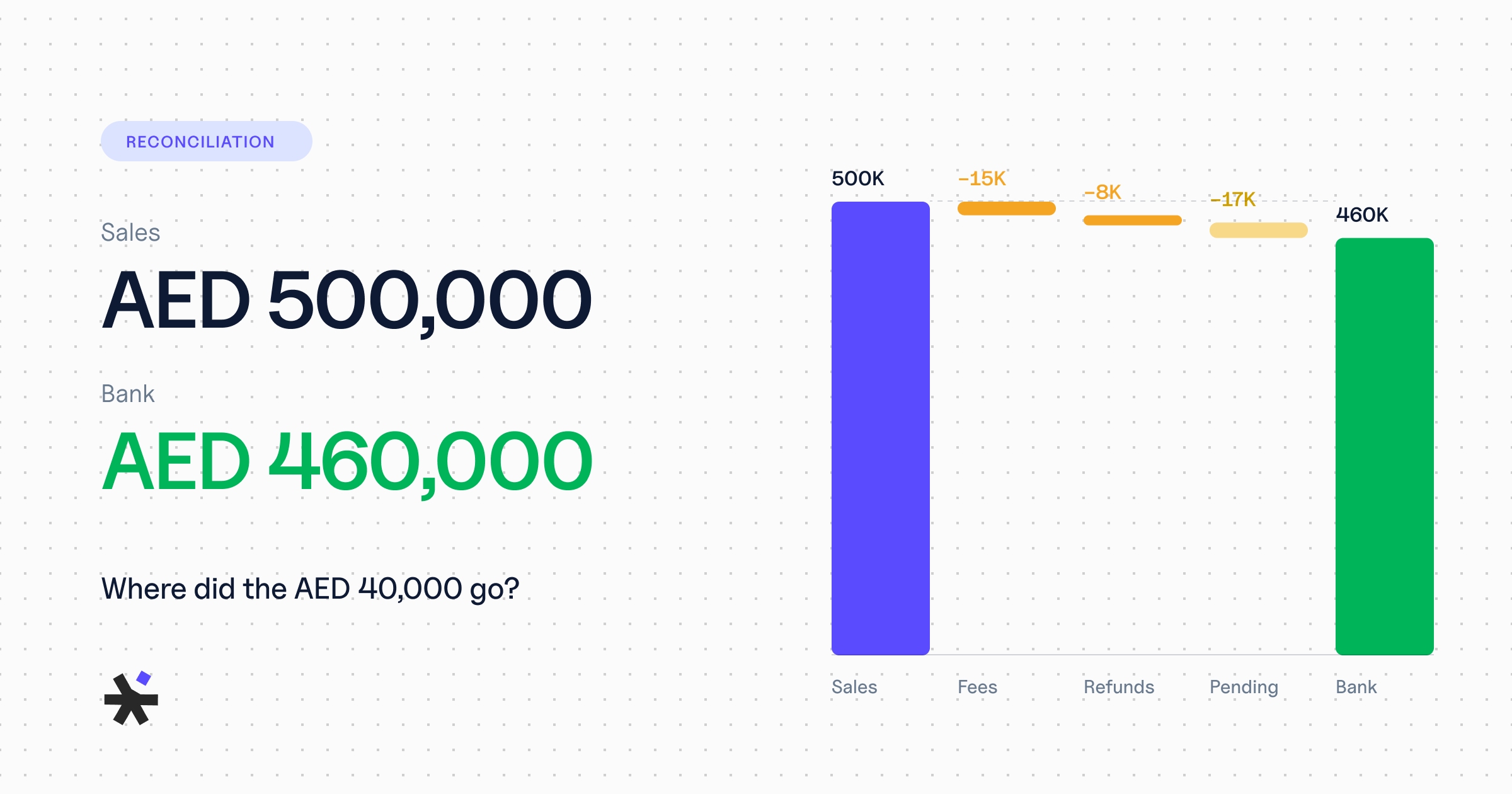
Your business records AED 500,000 in sales over a month, but only AED 460,000 shows up in your bank account. Where did the difference go?
The answer isn’t necessarily an accounting error or missing money. Sales, payment settlements, and bank deposits are different stages of a transaction, each recorded at a different point in time and often at a different value. Processing fees, refunds, chargebacks, settlement delays, and unmatched transactions can all further stretch the gap.
Knowing where your money sits and why the numbers differ takes an accountant’s attention: reviewing every source and reconciling the data before anything is posted to the books. Done this way, discrepancies are caught early, every transaction is accounted for, and your actual cash position stays clear.
In this article, we look at the most common reasons these mismatches happen and how an accountant who reconciles at the transaction level resolves them.
8 Common Reasons Your Financial Records Don't Add Up
Several things can pull your sales, settlements, and bank deposits apart. Some are routine deductions, while others come from delays, fragmented records, or incomplete books.
Here are eight common reasons why your sales, payment settlements, and bank balance may not match.
1. Refunds, Returns and Chargebacks
Refunds and chargebacks are the most common reason sales and bank deposits don’t match. A refund doesn’t always reverse the original payment. Providers often deduct refunds and chargebacks from a later settlement. A deposit can be lower because of a sale made weeks earlier, and the refund may land in a different accounting period from the original sale, since settlements run on different cycles, from T+1 to T+7 or T+14 days depending on the provider.
For retail and e-commerce businesses with frequent returns, this pulls sales reports, payment records, and bank deposits in different directions. As a result, management reports may show higher sales than the business actually earned, making it harder to understand revenue and assess performance. The deductions are easy to miss because they never appear as a line on the sales report.
Transaction-level reconciliation links each refund and chargeback to its original order. Propel makes sure these deductions land in the books, in the right period, instead of disappearing into an unexplained difference.
2. Payment Gateway Fees and Processing Charges
Payment gateways and card processors take their share before any money reaches you. When a customer pays AED 1,000, your bank may receive AED 975. The AED 25 went to transaction fees, processing charges, and other service costs, including VAT.
Your sales system records the full AED 1,000, but its payment data may not match what the PSP, POS terminal or BNPL provider shows in a settlement or on their dashboard. The bank only ever sees the net amount.
Management expects to see a AED 1,000 sale with AED 25 as an expense. The books do split it that way, but the split is hard to find in standard accounting reports. So the data gets exported from Xero or a similar system, and finance rebuilds the breakdown in Excel.
The fix is to reconcile the gross transaction value, the provider’s fees, and the net settlement as three separate figures. That lets us explain how much customers paid, what the provider deducted, and how much reached your bank.
This is where Propel comes in as your accountant and finance platform. We reconcile all three, so every deposit traces back to the transactions behind it, and we produce the management report that shows each sale broken down by its fees. The data no longer has to pass from accountant to finance team to owner before anyone can read it.
3. Delayed Payment Settlements
Providers rarely pay out instantly. Card processors, marketplaces, and gateways run on separate settlement timelines, creating inevitable delays. Payouts can take a few days, cross weekends and holidays, or spill into next month if the sale happens near month-end.
Your books record revenue when the sale happens, while your bank records it only when the money arrives. Part of your AED 500,000 is still with the provider, so the bank balance looks short even though nothing has gone wrong.
Businesses that mistake recorded revenue for available cash overestimate what they have, plan supplier payments and payroll against money that hasn’t landed, and can’t say which settlements are still pending.
Propel tracks what is expected, what has been received, and what is still outstanding. Timing differences stay visible instead of looking like shortfalls, and a late or missing payout is caught early.
4. Multiple Sales Channels and Payment Providers
Selling in more than one place means being paid through more than one system. An omnichannel retailer might take online orders on Shopify, sell through third-party marketplaces, and process in-store payments on POS systems, each with its own gateway or card processor, report format, and settlement schedule.
No single report shows the full picture. Finance teams spend hours collecting and matching records, and transactions end up duplicated, missed, or wrongly categorised. The problem grows with every channel you add.
Propel knows how these channels work. Our reconciliation engine brings orders, POS and order management records, payment provider data, and bank settlements together into one consistent set of books.
5. Foreign Currency Transactions and Exchange Rate Differences
If you accept payments in several currencies, you may record a sale in one currency and be paid in another. Providers and banks apply their own exchange rates, conversion fees, and settlement adjustments, so the amount you receive is rarely the original value.
Exchange rate movements add further differences, and conversion fees cut into margins. Without a breakdown, finance teams can’t tell whether a gap comes from fees, exchange rates, or a missing transaction.
Reconciliation needs to treat conversion charges and exchange differences as separate items. For businesses with cross-border sales or international payment providers, Propel accounts for them individually, so each difference is labelled and its effect on margin is visible.
6. Unreconciled Transactions and Clearing Account Balances
When a sale is recorded before the payment arrives, the amount sits in a clearing account. Once the payment settles and is matched to the bank deposit, that balance should clear to zero.
When matching is incomplete, records are missing, or settlements are matched to the wrong transactions, amounts stay parked there far longer than they should. The balance grows quietly until nobody can say what it is made of. Some of it is genuinely pending, some is fees that were never booked, and some may be settlements that never arrived. The balance sheet stops reflecting what you are really owed, and the longer items sit, the harder they are to trace.
This is where accountant-led reconciliation earns its place. Propel reconciles clearing accounts regularly, flags unmatched transactions, traces outstanding amounts, and keeps your books accurate.
7. Settlement Adjustments, Deductions and Marketplace Payouts
Marketplace and payment provider payouts usually bundle many transactions together. A single payout can cover hundreds of orders, minus commissions, advertising charges, refunds, penalties, reserves, and other deductions, so it can’t be matched to one sales report.
If nobody breaks a payout down, unexplained deductions go unchallenged, fees and commissions get booked in the wrong place, and a short payment can go unnoticed for months. Finding it later means rebuilding the payout order by order.
Propel traces marketplace payouts back to individual orders and accounts for every deduction, so order-level activity connects through to the final bank settlement.
8. Inconsistent Bookkeeping and Delayed Financial Closes
Sales reports, provider statements, and bank records can all be on hand and still not match. Each comes from a different system, in a different format, on a different timeline, and a single month can run to thousands of transactions, fees, refunds and bundled payouts. Reconciling all of that by hand is slow for anyone, so backlogs build, adjustments are missed, and discrepancies carry from one period into the next.
Reports go out of date, founders make decisions on incomplete information, cash flow planning becomes unreliable, and month-end takes longer because the team is still untangling old differences.
Regular closes fix this. Propel works toward a weekly close within 60 days and then moves toward daily closes, so discrepancies are caught while they are small and the numbers you rely on stay current. Because our platform does the matching, books close up to 30% faster.
How Propel Closes the Gap
You can’t close the gap between sales, payment settlements, and bank balances by looking at more reports. It closes when someone takes responsibility for the books, accounts for every transaction and can explain the result.
This is what Propel does. Propel is your accountant and partner for retail and e-commerce, F&B and real estate businesses in the UAE. We run your books, reconcile every transaction, file your VAT and corporate tax, and trace every payout back to the orders behind it, instead of giving your finance team another tool to operate.
Our reconciliation engine connects your sales and orders to the provider fees, refunds, and deductions behind them, and to the final bank settlement. Clearing accounts and outstanding transactions are tracked and cleared, so nothing sits unexplained.
Regular closes are part of the work. We work towards a weekly close within 60 days, then daily closes, with every figure built from reconciled records.
The result is numbers you can rely on. You can see your actual cash position, which settlements are still outstanding, and how the business is really performing, without waiting until month-end to find out.
Conclusion
Discrepancies between sales, payment settlements, and bank balances are normal, especially for businesses that sell across multiple channels and take payments through multiple providers. Fees, delays, refunds, and unmatched transactions will always pull the numbers apart.
What shouldn’t become normal is not knowing what those gaps are. An accountant who reconciles at the transaction level shows you where your money is, what has been received and what is still outstanding.
Propel is that accountant. We match every sale against its fees, refunds, and final bank settlement, file your VAT and corporate tax from the same reconciled books, and close your books on a regular schedule, so you always know your actual cash position.