
Omnichannel Retail & E-commerce Bookkeeping in the UAE: A Guide to Sales, Payouts and Reconciliation
Learn how UAE retail and e-commerce businesses can manage sales, payment payouts, and reconciliation across multiple channels for accurate books and cash flow.
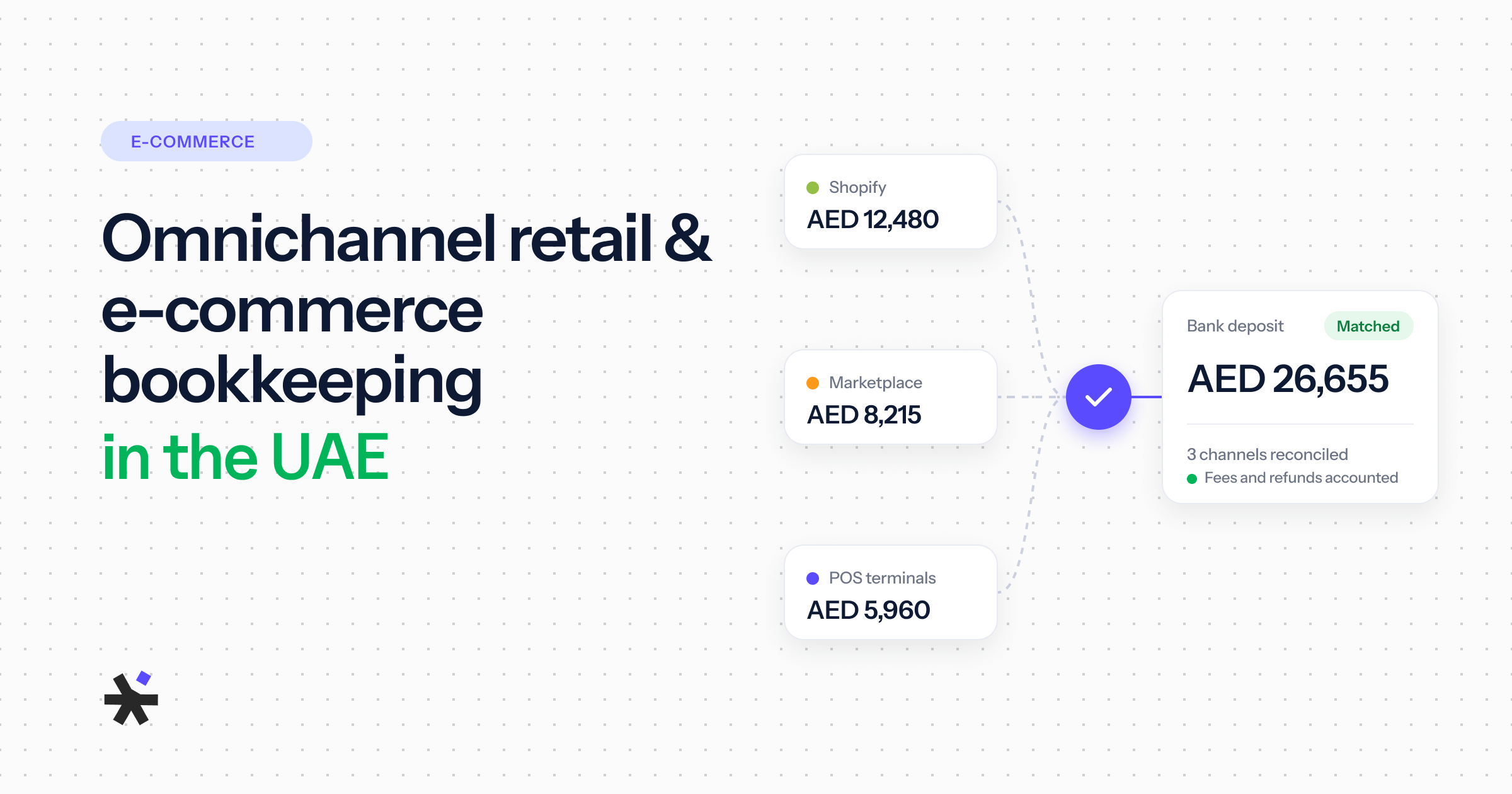
An omnichannel growth strategy gives retail and e-commerce brands more ways to sell, but it also makes their numbers harder to trust.
For a UAE retailer running a Shopify store, a presence on Amazon.ae or Noon, and a few physical outlets, every channel pays out on its own timetable. The order total on the dashboard, the amount a marketplace eventually transfers, and the card settlements from the terminals almost never match line for line.
Until those streams are pulled into one clear picture, it’s difficult to say what was really sold, what has actually been received, and how much cash is genuinely available.
In this guide, we explain how to reconcile orders, payouts, fees, refunds, and bank deposits across every channel.
What Is Omnichannel Retail and E-commerce Bookkeeping?
Omnichannel bookkeeping is the process of recording, tracking, and reconciling financial transactions across every channel a business sells through. Instead of treating the website, the marketplace listing, and the physical store as separate businesses, it treats them as one set of books.
That matters because each channel produces its own data:
- E-commerce platforms: Shopify and other online storefronts record orders, payments, refunds, and sales.
- Marketplaces: Third-party platforms record orders, commissions, fees, and seller payouts.
- Physical retail stores: POS systems capture in-store sales, card payments, cash transactions, and returns.
- Order Management Systems (OMS): These track orders, fulfilment, returns, and inventory movement across channels.
- Payment providers: Gateways and card processors handle transactions, fees, deductions, and settlements.
- Bank accounts: Net settlements and other business transactions ultimately appear here.
Each of these systems captures only its own slice of the transaction, and getting those slices to agree is where the difficulty begins.
Why Is Bookkeeping More Complex for Omnichannel Businesses?
A business selling through two or three channels can easily end up with dozens of records describing the same period in slightly different ways. Each is accurate on its own terms, but none of them was designed to line up with the others.
The complexity usually comes from a few places:
- Different formats: Each platform exports sales and transaction data in its own structure, with its own naming, fields, and level of detail.
- Different timing: An order may be recorded when it is placed, while the payment is captured later, and the money reaches the bank later still.
- Different settlement schedules: Marketplaces and payment providers pay out on their own cycles, often bundling many orders into a single transfer.
- Refunds and returns: These can hit sales and settlements at different times, sometimes in a different period from the original sale.
- Separate records for online and in-store sales: Physical outlets and web orders rarely live in the same system.
Finance teams then have to consolidate all of this to produce accurate financial statements.
The challenge, then, isn’t simply tracking how much a business sells. It’s understanding how each sale moves through the payment process and eventually reaches the bank and the accounting records.
Key Bookkeeping and Reconciliation Challenges for Omnichannel Retailers
Here are the seven problems that cause the most trouble when sales are spread across several channels:
1. Consolidating Sales Data Across Multiple Channels
Online orders sit in Shopify, in-store sales sit in the POS, and each marketplace keeps its own sales reports. Nothing connects them automatically.
Records get duplicated or categorised inconsistently, reporting periods don’t line up, and finance teams end up stitching together totals by hand.
Without a consolidated view, it’s hard to settle on a reliable revenue figure or see which channels are actually driving sales.
2. Reconciling Shopify Payouts with Actual Sales
Shopify records the order, while Shopify Payments or another provider processes the payment and transfers the money to your bank.
A single payout usually bundles many orders and is reduced by refunds and processing fees, so it rarely equals the sales total for the same period. Timing adds another gap, since the payout date is not the sale date.
The result is uncertainty about which orders a payout covers, whether every payment has arrived, and whether deductions were recorded correctly.
3. Reconciling Marketplace Payouts and Deductions
Marketplaces pay sellers periodically, and one payout can represent hundreds of orders.
Commissions, fulfilment charges, advertising fees, and refunds are netted off, and these deductions often appear separately from the original transactions. Each marketplace also runs its own settlement cycle.
Spotting an unexplained deduction or a missing settlement means checking at the transaction level, and without that, retailers can’t tell what a marketplace really earns them after costs.
4. Matching POS Transactions with Bank Settlements
In physical stores, the POS records the sale, but the card provider settles the funds later, after deducting its fees. POS totals and card settlements therefore seldom agree.
Cash and card takings need to be tracked separately, and refunds, voids, and reversals create further differences. For retailers with several outlets, each with its own POS and settlement account, pinpointing a discrepancy at store level becomes a task in itself.
5. Accounting for Returns, Refunds and Chargebacks Across Channels
A return can be processed through a different provider than the original payment, and the refund may be netted off a later settlement. It can also land in a different reporting period from the sale.
Chargebacks add deductions that arrive unannounced, and refund records in the POS, Shopify, and marketplaces often don’t match. If they are left unchecked, this distorts revenue and hides the true cost of returns.
6. Accounting for Payment Fees and Other Channel Costs
Every channel charges differently: payment processing fees, marketplace commissions, fulfilment fees, and other transaction-related deductions.
These are taken before the money reaches the bank, so they often sit in provider statements rather than in your sales records. If they aren’t captured and categorised properly, net revenue gets overstated, and it becomes difficult to judge what each channel really contributes.
7. Managing Clearing Accounts and Outstanding Settlements
Sales are often recorded before the cash arrives, so the amounts wait in clearing accounts until settlements are received and matched. With different cycles across channels, balances build up, unmatched items pile up, and short or missing payments can go unnoticed.
Over time, the clearing balance gets harder to explain, and the business loses sight of money that is recorded but not yet received, which makes its true cash position unclear.
How to Manage Bookkeeping and Reconciliation Across Sales Channels
The problems above share one cause: records are scattered, and nobody is matching them up. The fix is a steady routine that keeps every channel’s numbers tied back to the bank.
Here is a practical way to approach it:
1. Maintain Consistent Sales Records
Start by bringing sales data from Shopify, marketplaces, POS systems, and any other channels into one structure. Each transaction should be recorded the same way and be traceable to its original source, so any figure in the books can be checked against the system it came from.
2. Reconcile Gross Sales Against Net Settlements
Compare the original transaction values with provider statements and the deposits that actually hit the bank. The gap between gross sales and net settlement should be fully explained by fees, refunds, deductions, and timing differences. If part of the gap can’t be explained, that’s the item to investigate.
3. Track Outstanding Transactions
Keep an eye on payments that have been recorded but not yet settled. Reviewing clearing accounts regularly helps surface unmatched transactions and aging balances before they turn into missing money nobody noticed.
4. Close the Books Regularly
Waiting until month-end means discrepancies are found weeks after they occur, when they are harder to trace. A consistent reconciliation and bookkeeping rhythm, weekly or even more often for high-volume sellers, keeps the records current and the issues small.
How Propel Works for Omnichannel Businesses
Separate reports from Shopify, each marketplace, the POS, and the payment providers are useful, but they don’t give a business its books. Someone has to tie them together, chase the gaps, and stay accountable for the result. That is where Propel comes in.
Propel is your accountant and partner for retail, e-commerce, F&B and real estate businesses in the UAE. We run your books, reconcile every transaction, file your VAT and corporate tax, and close faster because our platform does the matching.
Here is what that covers:
- Your accountant, the full book: We prepare your monthly books, manage accounts payable and accounts receivable, and keep your business compliant with VAT and corporate tax filing.
- Reconciliation across payment channels: We trace every transaction, not just the final payout, from the original order through payment providers, fees, refunds, and deductions, all the way to the final bank settlement.
- Order-level financial tracking: When a marketplace or payment provider sends one aggregated payout, we connect it back to the underlying transactions, so you can see what each settlement actually contains.
- Regular financial closes: We work towards a weekly close within 60 days of onboarding, then daily, so discrepancies are caught while they are still easy to trace. Our platform does the matching, so books close up to 30% faster and month-end becomes a breeze.
- Management reporting: Our platform’s management reports show your cash position, cash flow, outstanding settlements, payment gaps, and overall financial performance, built on reconciled data.
With Propel, you keep selling across channels, and we make sure the numbers behind those sales can be trusted.
Conclusion
A sale isn’t finished when the customer pays. It’s finished when it reaches your bank and your books. When sales come through multiple digital and physical channels, keeping those books straight gets harder.
Every new sales channel you add brings its own sales, fees, refunds, and settlements, and totalling up what each platform reports won’t give an accurate picture of your company’s finances.
Reliable books come from reconciling transactions, accounting for deductions, tracking what has and hasn’t been settled, and making sure the final figures are recorded correctly in the accounts.
Propel is your accountant and partner here: we manage your books, reconcile payments, file your VAT and corporate tax, and give you a clear picture of your cash position.