
The Complete Guide to Outsourced Bookkeeping in the UAE
Learn how outsourced bookkeeping works in the UAE, what services it covers, how much it costs, and how to choose the right bookkeeping partner for your business.
As a business grows, so does the complexity of managing its finances. Bookkeeping has always been the backbone of running a business, but as customers, transaction volumes, sales channels, and payment platforms multiply, keeping track of it all becomes a serious task.
At that point, simply recording money in and money out is no longer enough. Businesses need accurate books, reconciled transactions, and a dependable view of where they stand financially.
For many companies in the UAE, outsourced bookkeeping offers a practical way to get there: professional support, without the cost and effort of building and managing a full in-house finance function.
In this guide, we explain what outsourced bookkeeping is, why businesses use it, how traditional bookkeeping arrangements work, and what to consider when choosing a provider.
What Is Outsourced Bookkeeping?
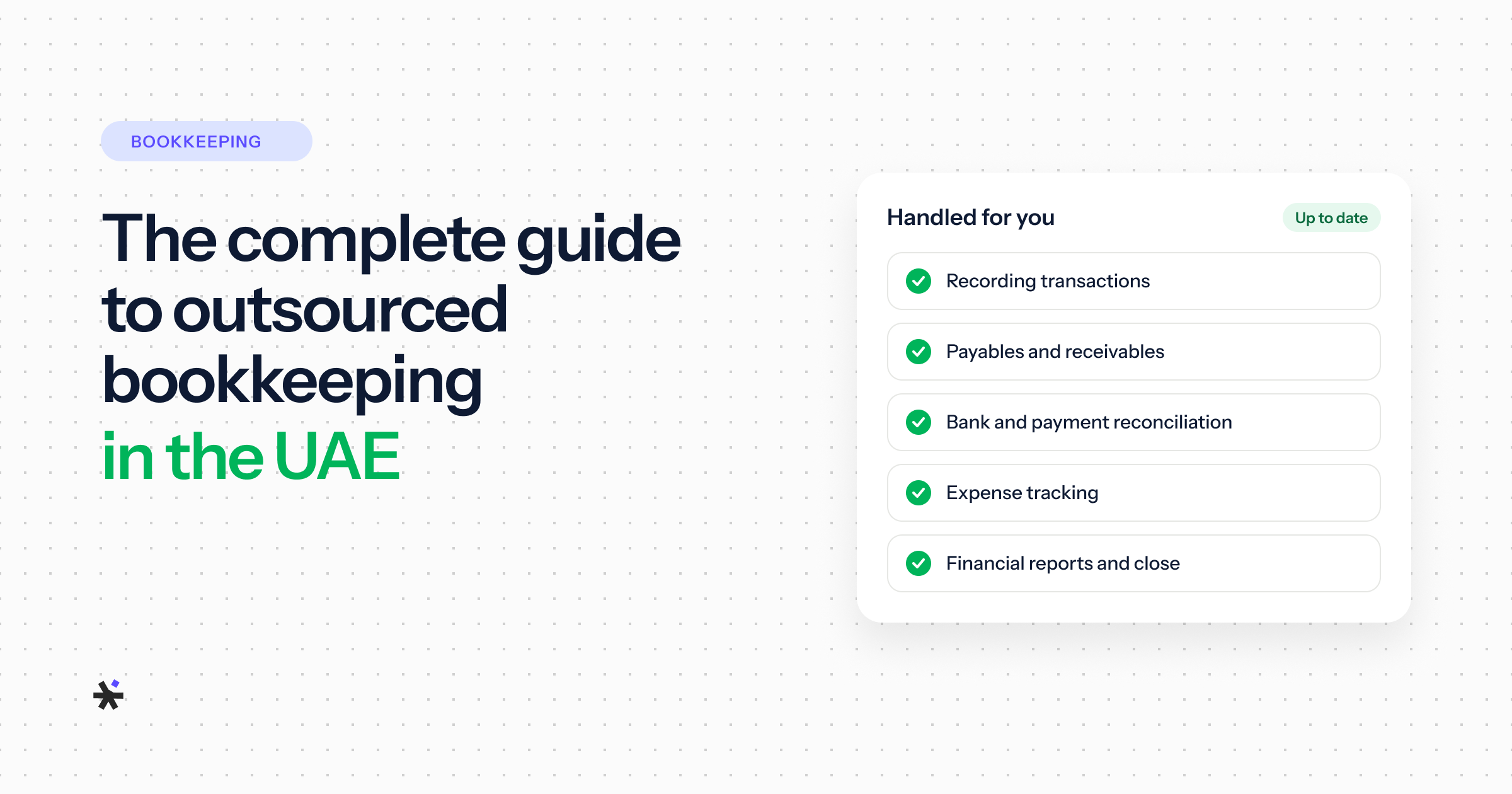
Outsourced bookkeeping means engaging an external provider to manage some or all of a business’s bookkeeping activities. Rather than handling day-to-day financial records internally, the business hands that work to a dedicated team. For many companies, outsourced bookkeeping UAE services are a way to keep records accurate and up to date without adding headcount.
A provider typically takes on:
- Recording financial transactions
- Managing accounts payable (AP) and accounts receivable (AR)
- Performing bank and payment reconciliation
- Tracking expenses
- Preparing regular financial reports
This is different from hiring an in-house bookkeeper, who is one person with limited capacity and no cover when they are away. A provider brings a team, defined processes, and continuity. Nor is it the same as relying on accounting software, which records and organises data but still needs people to categorise transactions correctly, resolve mismatches, and review the results.
Outsourced bookkeeping is also distinct from accounting. Bookkeeping maintains the financial record, making sure it is accurate and current. Accounting uses that record to interpret performance and support broader financial and compliance requirements.
Why Do Businesses Outsource Bookkeeping?
Cost matters, but it is rarely the only reason businesses outsource bookkeeping. More often, the decision is about getting better financial control with less internal strain. Here are the reasons that come up most:
- Dedicated expertise: Outsourcing gives businesses access to experienced bookkeepers without the effort of hiring and training an internal team. Because providers work across many businesses and setups, they’ve already dealt with the problems that trip up in-house teams.
- Predictable costs: A fixed or scope-based fee is far easier to plan around than salaries, benefits, software licences, and the overhead of managing staff.
- Room to scale: When transaction volumes rise, or new sales channels and payment methods are added, an outsourced team can absorb the extra work without another round of hiring.
- Consistent records: Regular posting, reconciliation, and review keep the books current, instead of letting entries pile up until a deadline forces a scramble.
- More time for the business: Founders and finance teams can step away from data entry and chasing mismatched payments, and put their attention on operations, customers, and growth.
When Should a Business Consider Outsourced Bookkeeping?
No single moment convinces a business that it needs to outsource. More often, it is a series of signs that build up as the business outgrows the way it currently handles its books.
- Rising transaction volumes: What was manageable with a few invoices a week becomes harder to keep accurate when hundreds of transactions flow through every month.
- Expansion across channels or locations: Adding sales channels, payment gateways, or locations multiplies the number of sources that need to be recorded and reconciled.
- Books falling behind: If entries are posted weeks late, or bank and payment mismatches stay unresolved, the books stop reflecting reality.
- Slow month-end close: A slow close usually points to backlogged records or manual reconciliation, and it delays every decision that depends on the numbers.
- Unclear cash position: If answering “how much cash do we really have?” means checking several sources and making a guess, the books are not doing their job.
- No full-time finance team yet: Many growing businesses need professional bookkeeping before they can justify the cost of building a dedicated internal team.
If several of these sound familiar, it may be time to look at outsourcing.
How Traditional Bookkeeping Works and the Challenges Businesses Face
In most businesses, bookkeeping is handled by an in-house bookkeeper, a small finance team, or an external accounting firm. The workflow is broadly the same in each case, and so are the pressure points that appear as the business grows.
Here is how it typically runs, and where it starts to strain:
1. Collecting Financial Records from Different Sources
An in-house bookkeeper chases down invoices, receipts, bank statements, payment provider reports, sales records, and expense documentation from different departments, employees, and systems. An external accounting firm, meanwhile, typically depends on the business to send these over at regular intervals.
For businesses selling across several channels and payment platforms, getting everything into one place is slow work. Records arrive in different formats, details go missing, and many documents have to be checked against others before they can be entered.
2. Recording Sales, Expenses, and Financial Transactions
Transactions are entered into accounting software or spreadsheets and assigned to the right accounts: customer sales, supplier invoices, operating expenses, and payments received. Some businesses make entries as transactions happen. Others update in batches.
So, the books are only as good as the entry behind them. Manual processes lead to duplicates, missed transactions, and expenses sitting in the wrong account, and as volumes grow, these errors get harder to spot and fix.
3. Reconciling Bank Accounts and Payment Providers
A recorded sale doesn’t mean the money has reached the bank. Bookkeepers compare accounting entries against bank statements and payment provider reports to confirm that what was recorded matches what was actually paid and deposited.
This means accounting for processing fees, refunds, chargebacks, and settlement delays. If a business uses several payment providers, it also has to match individual orders to combined payouts. Without a clear process, these differences pile up, and the books stop matching the bank.
4. Managing Accounts Payable and Receivable
Bookkeeping also tracks what the business owes and what it is waiting to be paid. Accounts payable covers supplier invoices, due dates, and outstanding bills, while accounts receivable covers customer invoices, incoming payments, and overdue balances. Both are updated as money moves.
When this is spread across systems or relies on manual follow-ups, businesses can lose track of unpaid invoices, upcoming payment commitments, and overdue receivables.
5. Preparing Financial Reports and Closing the Books
At the end of each period, bookkeepers review balances, check outstanding entries, reconcile accounts, and make adjustments before preparing the profit and loss statement, balance sheet, and cash flow statement.
The month-end close is where every earlier gap shows up. Missing documents, unrecorded transactions, and unresolved reconciliation differences all hold it up. Reports arrive late or incomplete, and owners struggle to understand their financial position when they need to.
Beyond Outsourced Bookkeeping: How Propel Works
Handing your bookkeeping to an outside provider doesn’t fix much if the books still arrive late, the payouts still don’t match the bank, and you still can’t say what your cash position is. The work has moved, but the problem hasn’t.
That’s the problem Propel solves. Propel is your accountant and partner for retail, e-commerce, F&B and real estate businesses in the UAE. We run your books, reconcile every transaction, file your VAT and corporate tax, and close faster because our platform does the matching.
1. We Are Your Accountant: The Full Book
We prepare your monthly books, handle accounts payable and accounts receivable, along with the day-to-day recording of financial transactions and keep your business compliant with VAT and corporate tax filing. Supplier invoices, customer payments, outstanding balances, and daily entries run as one connected process.
Many outsourced arrangements cover only selected tasks, like recording expenses or reconciling a bank statement, and leave the rest with the business. That is only a partial handover. With Propel, you get a complete accounting function without managing every transaction yourself.
2. Payment Reconciliation from Order to Bank Settlement
Propel traces every transaction, not just the final payout, across the full payment journey:
- Customer orders and sales
- Payment provider transactions
- Provider fees, refunds, and deductions
- Settlement amounts and timing
- Final bank deposits and accounting records
This matters most for retail and e-commerce businesses selling through Shopify, marketplaces, POS systems, and several payment providers. Each channel settles differently, and a single payout can bundle many orders after fees and adjustments.
The goal is simple: to know how every sale translates into money received and recorded in the books.
3. Regular Financial Closes: Weekly Within 60 Days, Then Daily
Propel moves businesses towards more frequent and reliable closes:
- Establish a consistent bookkeeping and reconciliation process.
- Work towards weekly financial closes within 60 days of onboarding.
- Move towards daily closes after that.
This frequency matters because it shortens the wait to understand your financial position. A business that closes monthly may only spot a settlement gap or recording error weeks after it happened. Frequent closes keep information current and problems small.
A close should be a regular part of operations, not something the business struggles through at the end of every month. Our platform does the matching, so books close up to 30% faster and month-end becomes a breeze.
4. Management Reporting That Goes Beyond the P&L
Reports built on reconciled records are more useful than reports built on assumptions. Our platform’s management reports give you:
- Cash position and cash flow
- Profit and loss statements
- Balance sheets
- Payment gaps and settlement delays
- Payment provider fees and refund patterns
- Clearing account balances and transaction-level detail
Together, these show founders and finance teams not just what the business earned, but where its money is and what remains outstanding. Accurate books should lead to information that helps you make operational decisions. We produce these reports directly from the reconciled books, so the data doesn’t have to pass from accountant to finance team to owner before anyone can read it.
5. Secure, Customer-Owned Financial Data
Technology has a clear role in accounting: handling volume, spotting mismatches, and making the work more efficient. At Propel, it serves the accounting, not the other way round.
- The business owns its financial data.
- Data is handled through Propel’s secure data server.
- AI and LLM capabilities work within the customer’s own data, not unrelated external information.
Technology should make accounting more efficient while keeping the customer’s financial data under their control.
Conclusion
Outsourced bookkeeping works when it changes what the business can see and trust, not just who does the data entry. It provides a dedicated accounting function, accurate records, consistent reconciliation, and financial information that arrives while it is still useful.
The right provider understands your operational complexity, takes responsibility for keeping the books accurate, and follows a reliable process for closing them. That is the difference between a provider that does your data entry and one that acts as your accountant. It matters more than any single feature or price point.
Looking for outsourced bookkeeping services in the UAE? Propel goes further: we are your accountant and financial partner, managing your books, reconciling payments and filing your VAT and corporate tax, so you always know your cash position.